martes, enero 23, 2018

Stoicism


Stoicism has a couple of fundamental ideas: one is that a meaningful life -a life worth living- is a life of practicing virtue. And this is virtue in the Greek/Roman sense of the term.

There are four fundamental virtues:
  1. Practical wisdom, which is the ability to navigate complex situations in the best possible way.
  2. Courage, which is not just physical courage, but moral courage, the courage to stand up for situations and for people.
  3. Temperance, the ability to exercise self control, not to go into excesses of any sorts.
  4. Justice, which is treating other people with fairness, the way you would like to be treated.
For a Stoic, if you practice sincerely the four virtues, that in and of itself, is both necessary and sufficient to make your life worth living.

The other one is the so called "Dichotomy of Control", best articulated by Epictetus, one of the late Roman Stoics, but present from the beginning of the philosophy, all the way back to Zeno of Citium, its founder, around 300 BC.

Dichotomy of Control says that wisdom and a serene life come out of understanding and internalizing that certain things are under your control and other things are not, and that you should focus on where your agency can actually be effective, that is, on the things that are under your control.

All external happenings are not under your control, you can only influence them. The things that are under your control are your values, your decision and your behaviors, your judgements about things.

[Massimo Pigliucci]

domingo, noviembre 19, 2017

A computational model of mind


The idea that the mind is software is a fairly popular delusion at the moment, but that hardly excuses a putatively serious philosopher for perpetuating it [...]. Usually, when confronted by the computational model of mind, it is enough to point out that what minds do is precisely everything that computers do not do, and therein lies much of a computer’s usefulness.

Really, it would be no less apt to describe the mind as a kind of abacus. In the physical functions of a computer, there is neither a semantics nor a syntax of meaning. There is nothing resembling thought at all. There is no intentionality, or anything remotely analogous to intentionality or even to the illusion of intentionality. There is a binary system of notation that subserves a considerable number of intrinsically mindless functions. And, when computers are in operation, they are guided by the mental intentions of their programmers and users, and they provide an instrumentality by which one intending mind can transcribe meanings into traces, and another can translate those traces into meaning again. But the same is true of books when they are “in operation.” And this is why I spoke above of a “Narcissan fallacy”: computers are such wonderfully complicated and versatile abacuses that our own intentional activity, when reflected in their functions, seems at times to take on the haunting appearance of another autonomous rational intellect, just there on the other side of the screen. It is a bewitching illusion, but an illusion all the same. And this would usually suffice as an objection to any given computational model of mind. 

David Bentley Hart

sábado, abril 29, 2017

Drowned in a sea of irrelevance


What Orwell feared were those who would ban books. What Huxley feared was that there would be no reason to ban a book, for there would be no one who wanted to read one. Orwell feared those who would deprive us of information. Huxley feared those who would give us so much that we would be reduced to passivity and egoism. Orwell feared that the truth would be concealed from us. Huxley feared the truth would be drowned in a sea of irrelevance. Orwell feared we would become a captive culture. Huxley feared we would become a trivial culture.

Neil Postman


domingo, abril 02, 2017

Temor y respeto de sí mismo


Todo hombre ha de entenderlo: no importa su enorme estatura, no importa su valentía, también él puede sucumbir al más ligero desliz. Temor y respeto de sí mismo juntamente, son los que dan entera seguridad al hombre. Ten sabido que donde se tolera la petulante soberbia y se deja que cada uno haga su antojo, por próspera que sea, aunque le soplen vientos propicios, lentamente se habrá de hundir la nave de la ciudad.

Sófocles: Ajax

sábado, noviembre 26, 2016

Fidel


dirán exactamente de fidel
gran conductor el que incendió la historia etcétera
pero el pueblo lo llama el caballo y es cierto
fidel montó sobre fidel un día
se lanzó de cabeza contra el dolor contra la muerte
pero más todavía contra el polvo del alma
la Historia parlará de sus hechos gloriosos
prefiero recordarlo en el rincón del día
en que miró su tierra y dijo soy la tierra
en que miró su pueblo y dijo soy el pueblo
y abolió sus dolores sus sombras sus olvidos
y solo contra el mundo levantó en una estaca
su propio corazón el único que tuvo
lo desplegó en el aire como una gran bandera
como un fuego encendido contra la noche oscura
como un golpe de amor en la cara del miedo
como un hombre que entra temblando en el amor
alzó su corazón lo agitaba en el aire
lo daba de comer de beber de encender
fidel es un país
yo lo vi con oleajes de rostros en su rostro
la Historia arreglará sus cuentas allá ella
pero lo vi cuando subía gente por sus hubiéramos
buenas noches Historia agranda tus portones
entramos con fidel con el caballo

Juan Gelman

viernes, mayo 20, 2016

La rebelión de las masas


Cuando una civilización no ha logrado evitar que la satisfacción de un cierto número de sus partícipes tenga como premisa la opresión de otros, de la mayoría quizá -y así sucede en todas las civilizaciones actuales-, es comprensible que los oprimidos desarrollen una intensa hostilidad contra la civilización que ellos mismos sostienen con su trabajo, pero de cuyos bienes no participan sino muy poco. En este caso no puede esperarse por parte de los oprimidos una asimilación de las prohibiciones culturales, pues, por el contrario, se negarán a reconocerlas, tenderán a destruir la civilización misma y eventualmente a suprimir sus premisas. La hostilidad de estas clases sociales contra la civilización es tan patente que ha monopolizado la atención de los observadores, impidiéndoles ver la que latentemente abrigan también las otras capas sociales más favorecidas. No hace falta decir que una cultura que deja insatisfecho a un núcleo tan considerable de sus partícipes y los incita a la rebelión no puede durar mucho tiempo, ni tampoco lo merece.

Freud: El Povernir de una Ilusión (1927)

viernes, febrero 12, 2016

Mozart


Mozart es un volcán. Una avalancha. Un huracán. Hay idiotas que no creen que Dios vino al mundo y se hizo hombre. Hace 260 años, una de tantas veces. El Maestro vive. Nos enseña que hay algunas cosas, casi siempre pequeñas y nocturnas, que hacen de la experiencia humana algo soportable y llevadero. Que el genio es infantil, irreverente y sempiterno. Mozart es la locomotora que hala el tren que nunca alcanzaremos. Es una bengala arrojada al pozo desde donde contemplamos atónitos las sombras. Es el cuerno que derriba la muralla del silencio. Su alma derramada nos salpica y nos empapa de gloria, por los siglos de los siglos.

martes, agosto 11, 2015

A new man beyond Europe


We must abandon our dreams and say farewell to our beliefs and former friendships. Let us not lose time in useless laments or sickening mimicry. Let us leave this Europe which never stops talking of man yet massacres him at everyone of its street corners, at every corner of the world.
For centuries Europe has brought the progress of other men to a halt and enslaved them for its own purposes and glory; for centuries it has stifled virtually the whole of humanity in the name of a so-called "spiritual adventure." Look at it now teetering between atomic destruction and spiritual disintegration.
And yet nobody can deny its achievements at home have not been crowned with success. Europe has taken over leadership of the world with fervor, cynicism, and violence. And look how the shadow of its monuments spreads and multiplies. Every movement Europe makes bursts the boundaries of space and thought.
Europe has denied itself not only humility and modesty but also solicitude and tenderness. 
Its only show of miserliness has been toward man, only toward man has it shown itself to be niggardly and murderously carnivorous.
So, my brothers, how could we fail to understand that we have better things to do than follow in that Europe's footsteps?
This Europe, which never stopped talking of man, which never stopped proclaiming its sole concern was man, we now know the price of suffering humanity has paid for everyone of its spiritual victories. 
Come, comrades, the European game is finally over, we must look for something else. We can do anything today provided we do not ape Europe, provided we are not obsessed with catching up with Europe. 
Europe has gained such a mad and reckless momentum that it has lost control and reason and is heading at dizzying speed towards the brink from which we would be advised to remove ourselves as quickly as possible. 
It is all too true, however, that we need a model, schemas and examples. For many of us the European model is the most elating. But we have seen in the preceding pages how misleading such an imitation can be. European achievements, European technology and European lifestyles must stop tempting us and leading us astray. 
When I look for man in European lifestyles and technology I see a constant denial of man, an avalanche of murders. Man's condition, his projects and collaboration with others on tasks that strengthen man's totality, are new issues which require genuine inspiration. 
Let us decide not to imitate Europe and let us tense our muscles and our brains in a new direction. Let us endeavor to invent a man in full, something which Europe has been incapable of achieving. 
Two centuries ago, a former European colony took it into its head to catch up with Europe. It has been so successful that the United States ofAmerica has become a monster where the flaws, sickness, and inhumanity of Europe have reached frightening proportions.
Comrades, have we nothing else to do but create a third Europe? The West saw itself on a spiritual adventure. It is in the name of the Spirit, meaning the spirit of Europe, that Europe justified its crimes and legitimized the slavery in which it held four fifths of humanity.
...
Today we are witnessing a stasis of Europe. Comrades, let us flee this stagnation where dialectics has gradually turned into a logic of the status quo. Let us reexamine the question of man. Let us reexamine the question of cerebral reality, the brain mass of humanity in its entirety whose affinities must be increased, whose connections must be diversified and whose communications must be humanized again. 
Come brothers, we have far too much work on our hands to revel in outmoded games. Europe has done what it had to do all things considered, it has done a good job; let us stop accusing it, but let us say to it firmly it must stop putting on such a show. We no longer have reason to fear it, let us stop then envying it.
The Third World is today facing Europe as one colossal mass whose project must be to try and solve the problems this Europe was incapable of finding the answers to. 
But what matters now is not a question of profitability, not a question of increased productivity, not a question of production rates. No, it is not a question of back to nature. It is the very basic question of not dragging man in directions which mutilate him, of not imposing on his brain tempos that rapidly obliterate and it. The notion of catching up must not be as a pretext to brutalize man, to tear him from himself and his inner consciousness, to break him, to kill him. 
No, we do not want to catch up with anyone. But what we want is to walk in the company of man, every man, night and day, for all times.
The Third World must start over a new history of man which takes account of not only the occasional prodigious theses maintained by Europe but also its crimes, the most heinous of which have been committed at the very heart of man, the pathological dismembering of his functions and the erosion of his unity, and in the context of the community, the fracture, the stratification and the bloody tensions fed by class, and finally, on the immense scale of humanity, the racial hatred, slavery, exploitation and, above all, the bloodless genocide whereby one and a half billion men have been written off. 
So comrades, let us not pay tribute to Europe by creating states, institutions, and societies that draw their inspiration from it. Humanity expects other things from us than this grotesque and generally obscene emulation.
If we want to transform Africa into a new Europe, America into a new Europe, then let us entrust the destinies of our countries to the Europeans. They will do a better job than the best of us.
But if we want humanity to take one step forward, if we want to take it to another level than the one where Europe has placed it, then we must innovate, we must be pioneers. 
If we want to respond to the expectations of our peoples, we must look elsewhere besides Europe.
Moreover, if we want to respond to the expectations of the Europeans we must not send them back a reflection, however ideal, of their society and their thought that periodically sickens even them.
For Europe, for ourselves and for humanity, comrades, we must make a new start, develop a new way of thinking, and endeavor to create a new man. 

Frantz Fanon: The Wretched of the Earth

martes, abril 28, 2015

these mad dogs of glory


Van Gogh writing his brother for paints
Hemingway testing his shotgun
Celine going broke as a doctor of medicine
the impossibility of being human
Villon expelled from Paris for being a thief
Faulkner drunk in the gutters of his town
the impossibility of being human
Burroughs killing his wife with a gun
Mailer stabbing his
the impossibility of being human
Maupassant going mad in a rowboat
Dostoevsky lined up against a wall to be shot
Crane off the back of a boat into the propeller
the impossibility
Sylvia with her head in the oven like a baked potato
Harry Crosby leaping into that Black Sun
Lorca murdered in the road by the Spanish troops
the impossibility
Artaud sitting on the madhouse bench
Chatterton drinking rat poison
Shakespeare a plagiarist
Beethoven with a horn stuck into his head against deafness
the impossibility the impossibility
Nietzsche gone totally mad
the impossibility of being human
all too human
this breathing
in and out
out and in
these punks
these cowards
these champions
these mad dogs of glory
moving this little bit of light toward
us
impossibly.


Charles Bukowski: Beasts Bounding Through Time

sábado, abril 11, 2015

Los hombres extraordinarios


La inexactitud consiste en que yo no dije, como usted ha entendido, que los hombres extraordinarios están autorizados a cometer toda clase de actos criminales. Sin duda, un artículo que sostuviera semejante tesis no se habría podido publicar. Lo que yo insinué fue tan sólo que el hombre extraordinario tiene el derecho..., no el derecho legal, naturalmente, sino el derecho moral..., de permitir a su conciencia franquear ciertos obstáculos en el caso de que así lo exija la realización de sus ideas, tal vez beneficiosas para toda la humanidad...

En mi opinión, si los descubrimientos de Képler y Newton, por una circunstancia o por otra, no hubieran podido llegar a la humanidad sino mediante el sacrificio de una, o cien, o más vidas humanas que fueran un obstáculo para ello, Newton habría tenido el derecho, e incluso el deber, de sacrificar esas vidas, a fin de facilitar la difusión de sus descubrimientos por todo el mundo. Esto no quiere decir, ni mucho menos, que Newton tuviera derecho a asesinar a quien se le antojara o a cometer toda clase de robos. En el resto de mi artículo, si la memoria no me enga- ña, expongo la idea de que todos los legisladores y guías de la humanidad, empezando por los más antiguos y terminando por Licurgo, Solón, Mahoma, Napoleón, etcétera; todos, hasta los más recientes, han sido criminales, ya que al promulgar nuevas leyes violaban las antiguas, que habían sido observadas fielmente por la sociedad y transmitidas de generación en generación, y también porque esos hombres no retrocedieron ante los derramamientos de sangre (de sangre inocente y a veces heroicamente derramada para defender las antiguas leyes), por poca que fuese la utilidad que obtuvieran de ello.

Incluso puede decirse que la mayoría de esos bienhechores y guías de la humanidad han hecho correr torrentes de sangre. Mi conclusión es, en una palabra, que no sólo los grandes hombres, sino aquellos que se elevan, por poco que sea, por encima del nivel medio, y que son capaces de decir algo nuevo, son por naturaleza, e incluso inevitablemente, criminales, en un grado variable, como es natural. Si no lo fueran, les sería difícil salir de la rutina. No quieren permanecer en ella, y yo creo que no lo deben hacer.

Ya ven ustedes que no he dicho nada nuevo. Estas ideas se han comentado mil veces de palabra y por escrito. En cuanto a mi división de la humanidad en seres ordinarios y extraordinarios, admito que es un tanto arbitraria; pero no me obstino en defender la precisión de las cifras que doy. Me limito a creer que el fondo de mi pensamiento es justo. Mi opinión es que los hombres pueden dividirse, en general y de acuerdo con el orden de la misma naturaleza, en dos categorías: una inferior, la de los individuos ordinarios, es decir, el rebaño cuya única misión es reproducir seres semejantes a ellos, y otra superior, la de los verdaderos hombres, que se complacen en dejar oír en su medio palabras nuevas. Naturalmente, las subdivisiones son infinitas, pero los rasgos característicos de las dos categorías son, a mi entender, bastante precisos. La primera categoría se compone de hombres conservadores, prudentes, que viven en la obediencia, porque esta obediencia los encanta. Y a mí me parece que están obligados a obedecer, pues éste es su papel en la vida y ellos no ven nada humillante en desempeñarlo. En la segunda categoría, todos faltan a las leyes, o, por lo menos, todos tienden a violarlas por todos sus medios.

Naturalmente, los crímenes cometidos por estos últimos son relativos y diversos. En la mayoría de los casos, estos hombres reclaman, con distintas fórmulas, la destrucción del orden establecido, en provecho de un mundo mejor. Y, para conseguir el triunfo de sus ideas, pasan si es preciso sobre montones de cadáveres y ríos de sangre. Mi opinión es que pueden permitirse obrar así; pero..., que quede esto bien claro..., teniendo en cuenta la clase e importancia de sus ideas. Sólo en este sentido hablo en mi artículo del derecho de esos hombres a cometer crímenes. (Recuerden ustedes que nuestro punto de partida ha sido una cuestión jurídica). Por otra parte, no hay motivo para inquietarse demasiado. La masa no les reconoce nunca ese derecho y los decapita o los ahorca, dicho en términos generales, con lo que cumple del modo más radical su papel conservador, en el que se mantiene hasta el día en que generaciones futuras de esta misma masa erigen estatuas a los ajusticiados y crean un culto en torno de ellos..., dicho en términos generales. Los hombres de la primera categoría son dueños del presente; los de la segunda del porvenir. La primera conserva el mundo, multiplicando a la humanidad; la segunda empuja al universo para conducirlo hacia sus fines. Las dos tienen su razón de existir. En una palabra, yo creo que todos tienen los mismos derechos. Vive donc la guerre éternelle..., hasta la Nueva Jerusalén, entiéndase.

Fiódor Dostoyevski: Crímen y Castigo

domingo, enero 25, 2015

On being taken


While literature has dealt with all manner of erotic conflicts, the simplest external motive for conflict has remained untouched, due to its obviousness. That is the phenomenon of being already taken: that a person beloved by us is inaccessible not because of inner antagonisms and inhibitions, too much coldness or overly repressed warmth, but because a relationship already exists, which excludes a new one. The abstract temporal order plays in truth the role which one would like to ascribe to the hierarchy of the feelings. The state of being taken, leaving aside freedom of choice and the decision, also has something wholly accidental about it, which appears to thoroughly contradict the claim of freedom. Even and exactly in a society healed from the anarchy of commodity production, there would scarcely be rules regarding how and in what order one got to meet people. Were it any different, then such an arrangement would equate to the most unbearable assault on freedom. For that reason, the priority of what is accidental has powerful reasons on its side: if a new person is preferred over another, then the latter is slighted, because the past of the common life is annulled, experience itself is, as it were, crossed out. The irreversibility of time sets an objective moral criterion. But this latter is entwined with mythos, like abstract time itself. The exclusivity posited in it develops according to its own concept into the exclusive rule of hermetically sealed groups, finally to that of large-scale industry. Nothing can be more touching than the worry of lovers, that a new person could attract love and tenderness –their finest possessions, just because they cannot be possessed– precisely by means of that newness, which is itself produced by the privilege of the older. But from this touchingness, whose disintegration would mean the simultaneous disintegration of all warmth and snugness [Geborgensein], leads an irresistible path from the aversion of the little child to its younger siblings and the contempt of the fraternity brother to the pledge, to the immigration laws which exclude all non-Europeans in social democratic Australia, all the way to the Fascist extermination of racial minorities, wherein in fact warmth and snugness explode into nothingness. It is not only, as Nietzsche knew, that all good things were once evil: even the most tender of these, left to its own momentum, has the tendency to culminate in unthinkable barbarity.


It would be idle to try to point out a path leading out of such entanglement. Yet the baleful moment can be named, which brings this entire dialectic into play. It lies in the exclusive character of what is first. The original relationship, in its mere immediacy, already presupposes that abstract temporal order. The concept of time is historically formed on the basis of the social order of property. But the desire for ownership reflects time as fear of losing, of irretrievability. What is, is experienced in relation to its possible non-being. It is thereby turned into a possession and precisely in such petrification to something functional, which can be exchanged for another, equivalent possession. Once become entirely a possession, the beloved human being is actually no longer even looked at. Abstraction in love is the complement of exclusivity, which manifests itself deceptively, as its opposite, as the clinging to the appearance of someone-just-so. The object of this conventionalism slips out of the latter’s hands, precisely because it is turned into an object, and forfeits the human beings, which it degrades to “mine”. If human beings were no longer possessions of any kind, then they could also no longer be exchanged. The true affection would be one, which speaks specifically to the other, holding fast to beloved traits and not to the idol of personality, the mirror-reflection of possession. What is specific is not exclusive: it lacks the impulse towards totality. But in another sense it is nevertheless exclusive: it prevents the substitution of the experience which is indissolubly bound to it, not so by forbidding such, but because its pure concept prevents this substitution from happening in the first place. The protection of what is entirely determinate is that it cannot be repeated, and that is why it tolerates the other. The property relationship in human beings, the exclusive right of priority, recalls to mind the old saying: Lord, they’re only human beings, which one, doesn’t really matter. The affection which knows nothing of such wisdom, need not fear infidelity, because it would be immune to faithlessness.


Theodor Adorno: Minima Moralia, 49.- Morality and Temporal Sequence

martes, diciembre 30, 2014

An enormous imitating machine


In the science of man and culture today there is a unilateral swerve away from anything that could be called mimicry, imitation or mimesis. And yet there is nothing, or next to nothing, in human behavior that is not learned, and al learning is based on imitation. If human beings suddenly ceased imitating, all forms of culture would vanish. Neurologists remind us frequently that the  human brain is an enormous imitating machine. To develop a science of man it is necessary to compare  human imitation with animal mimicry, and to specify the properly human modalities of mimetic behavior, if they indeed exist.

René Girard, Things Hidden since the Foundation of the World.

lunes, diciembre 29, 2014

Shamán blanco con calzoncillos de nylon


Escribir es dibujar mi mandala y a la vez recorrerlo,
inventar una purificación purificándose;
tarea de pobre shamán blanco con calzoncillos de nylon.

Rayuela, Capítulo 82
Julio Cortázar

jueves, julio 10, 2014

Philosophers should not be specialists


Even the analysis of science—the ‘philosophy of science’—is threatening to become a fashion, a specialism. Yet philosophers should not be specialists. For myself, I am interested in science and in philosophy only because I want to learn something about the riddle of the world in which we live, and the riddle of man’s knowledge of that world. And I believe that only a revival of interest in these riddles can save the sciences and philosophy from narrow specialization and from an obscurantist faith in the expert’s special skill, and in his personal knowledge and authority; a faith that so well fits our ‘post-rationalist’ and ‘post-critical’ age, proudly dedicated to the destruction of the tradition of rational philosophy, and of rational thought itself.

Karl Popper: The Logic of Scientific Discovery, 1958

sábado, mayo 24, 2014

La Alegría del Sabio


Cuando Alejandro iba avanzando por la India y arrasaba en su campaña pueblos que apenas sus propios vecinos conocían, durante el asedio de una ciudad, mientras recorría las murallas para descubrir los puntos más débiles de la fortificación, herido por una flecha se obstinó, no obstante, en cabalgar para conseguir su objetivo. 
Cuando después, cortada la sangre y seca la herida, crecía el dolor y se le hinchaba la pierna y se entumecía colgando sobre el caballo, obligado a detenerse, dijo:
"Todos juran que soy hijo de Júpiter, pero esta herida me recuerda que soy un mortal".
Hagamos lo mismo nosotros. La adulación nos hace fatuos, cada uno dentro de su esfera. Digamos, pues:
"Ustedes dicen que soy prudente, pero veo cuántas cosas vanas ambiciono, y cuántas que me serán perjudiciales deseo. Ni siquiera entiendo aquello que enseña a los animales la saciedad, esto es, la medida que han de tener al comer y beber: aún ignoro mi capacidad".
Ahora te enseñaré a reconocer que no eres sabio. El sabio es el hombre lleno de alegría, sonriente, sereno e inmutable; él vive al mismo nivel que los dioses. Ahora, examínate tú mismo. Si nunca estás triste, si ninguna esperanza angustia tu alma con la expectación del futuro, si el tono de tu alma elevada y contenta de ella misma se mantiene igual noche y día, has llegado a la cima del bienestar humano. Pero si deseas los placeres, si los buscas todos y en todas partes, sabe que te falta tanto en sabiduría como en alegría. 
Deseas llegar, pero te equivocas, si esperas conseguirlo entre las riquezas, entre los honores, es decir, si buscas la alegría entre los afanes. Estas cosas por las cuales te esfuerzas, esperando la alegría y el placer, son causas del dolor. 
Todos tienden ciertamente al gozo, pero ignoran donde se consigue el gozo pleno y duradero: uno lo busca en los festines y el desenfreno, el otro en la ambición y en la multitud de clientes que le rodea, el otro en la amante, el otro en la vana ostentación de los estudios liberales y de las letras que no protegen de nada. A todos estos los seducen diversiones falaces y efímeras, como la embriaguez, que paga con largo tiempo de tedio la loca alegría de una hora, como los aplausos y las aclamaciones del favor popular, con tan grandes angustias compradas y expiadas.
Reflexiona, pues, que el efecto de la sabiduría es una alegría siempre igual. El alma del sabio es como el cielo que está sobre la luna: allí reina siempre la serenidad.
Aquí tienes, pues, un motivo para desear la sabiduría: que al sabio no le falta ni un solo instante la alegría. Esta alegría no nace sino de la consciencia de las virtudes propias: solo el fuerte puede estar alegre, solo el justo, solo el temperante.
¿Qué, dices, los necios y los malos no disfrutan? No más que los leones que han cogido su presa. Cuando se han fatigado con vino y orgías, cuando ya la noche se les acaba el pleno de la diversión, cuando ya los placeres, metidos en el cuerpo con más cantidad de la que cabe en su pobreza, les comienzan a supurar, entonces los malditos se exclaman como aquél verso de Virgilio: 
"Cómo pasamos la última noche en medio de falsos goces, ya lo sabes."
(Hablaba de la última noche antes del saqueo de Troya) Los libertinos pasan cada noche en medio de falsos goces como si fuera la última; pero la alegría que corresponde a los dioses y a sus seguidores, no se interrumpe ni se acaba. Terminaría si fuese externa. Puesto que no depende del favor ajeno, tampoco depende del antojo ajeno. La fortuna no arrebata lo que no otorga.

Séneca: Cartas a Lucilio (Carta LIX).

sábado, abril 19, 2014

Dejar de ser mono


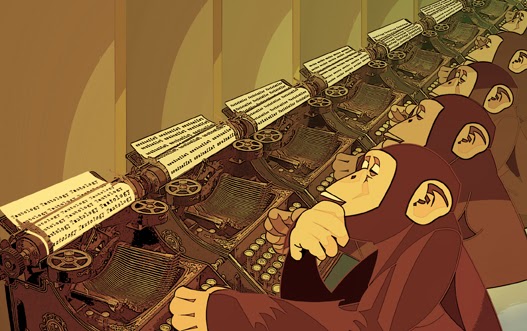
El espíritu de investigación no tiene límites. En los Estados Unidos y en Europa han descubierto a últimas fechas que existe una especie de monos hispanoamericanos capaces de expresarse por escrito, réplicas quizá del mono diligente que a fuerza de teclear una máquina termina por escribir de nuevo, azarosamente, los sonetos de Shakespeare. Tal cosa, como es natural, llena estas buenas gentes de asombro, y no falta quien traduzca nuestros libros, ni, mucho menos, ociosos que los compren, como antes compraban las cabecitas reducidas de los jíbaros. Hace más de cuatro siglos que fray Bartolomé de las Casas pudo convencer a los europeos de que éramos humanos y de que teníamos un alma porque nos reíamos; ahora quieren convencerse de lo mismo porque escribimos.

Augusto Monterroso

domingo, febrero 09, 2014

LHC: Literary Human Collider


Si las matemáticas son el lenguaje del universo, las letras, la literatura es el lenguaje del hombre, y su estudio, por lo tanto, es el estudio del ser humano. Escondido en el fondo de infinitos volúmenes yace el secreto de quiénes somos. Y nosotros hacemos colisionar frases y palabras, una y otra vez, para obtener los componentes fundamentales y descifrar sus orígenes, predecir sus trayectorias, y aprehender las fuerzas que nos separan o nos mantienen unidos. Nuestro método es simple, pero eficaz.

domingo, febrero 02, 2014

Vida y muerte


... el contacto prematuro y repetido con la muerte conduce a una mentalidad especial que nos hace sensibilizar ante la dureza y la crueldad de la vida ordinaria; y, digámoslo claro: también su cinismo.

... la única manera sana y noble, es más, la única manera sensata y religiosa de contemplar la muerte es considerarla y sentirla como parte integrante, como la sagrada condición sine qua non de la vida, y no separarla de ella mediante alguna entelequia, no verla como su antítesis y, menos aún, tratar de resistirse de manera antinatural, pues eso sería justo lo contrario de lo sano, noble, sensato y religioso. Los antiguos decoraban sus sarcófagos con símbolos de la vida y la fecundidad, incluso con símbolos obscenos. Según el concepto de religiosidad de los antiguos, lo sagrado y lo obsceno con frecuencia se daban la mano. Aquellos hombres sabían honrar la muerte. Mire, la muerte es digna de honores en tanto es la cuna de la vida, el seno materno de la renovación. Sin embargo, vista como la antítesis de la vida y separada de ella se convierte en un fantasma, en una máscara horrenda o en algo peor todavía. Porque la muerte entendida como fuerza espiritual independiente es una fuerza enteramente depravada; cuya perversa seducción sin duda es sinónimo del más espantoso extravío del espíritu humano.

Thomas Mann: La montaña mágica.

miércoles, enero 29, 2014

A Gelman


Cuando abrí uno de sus libros por vez primera
salieron pajaritos de dolor volando alegres /piando
cagándose sobre las revoluciones
pueblos de mujeres disfrazados de una sola
mujeres solas locas iracundas 
rabiosas de tanto amor que les daban
que nunca será tanto como el amor que ellas dieron

A veces por las noches desde el librero
a veces sobre la cama o por debajo de las
cobijas cuando leía hasta caer dormido
los pajaritos piaban
se quedaban cantando toda la noche
desde los sueños que habremos de tener cuando alcancemos a Juan
cuando nos tienda la mano para decirnos con su vocecita de trino
que todo esta bien
que nos ha estado esperando
que acá ya no hay más poetas /que uno es la poesía 
que se escribe a sí misma a través de Juan
que nunca dejó de buscarnos
desde que nos supo nacidos en el cautiverio 
contra el que se lanzó de cabeza con las letras por delante

Ahora el gran cielo de la poesía incluye también a Juan
porque Juan era sólo un nombre que dimos a alguno de esos pajaritos
y Juan era toda la parvada también /y más
ahora es el aire que les empuja las alas
el alpiste con el que han de cagarse sobre la muerte sobre las revoluciones
En el libro de la belleza hay un nuevo poema:
"Lamento por Juan Gelman"
Juan debe andar por allí revoloteando sobre la plaza de su pueblo
alejándose de la locura
escapándosele a la muerte
acercándose a la soledad para destrozarla con sus alitas
que soplan vientos para que las alas de la poesía vuelen

y que se alejan cantando
   en hombros de todos los ruiseñores

DGG

sábado, enero 25, 2014

Beauty


And then they say "oh, it's beautiful over there, isn't it?", and you say "yes, it is", and what everybody thinks but doesn't say is "then how come you are not there?". And you think -you try to convince yourself- that it's because you want more. You want different. And as human beings we are doomed to always want some more. We are doomed to desire. Beauty is just not enough.

But then one day you try to find beauty, and all there is this: cities, streets, your dog barking at 6 a.m., your mother's hands, the smell of your hair, an egg sandwich, a carton of milk. That's all there is, and it is not enough. And it isn't because you are looking in the wrong place. You are looking with the wrong eyes. You are asking the wrong questions. You are failing to see that all there is is this. All there is, just is.

And it is beautiful.